
The short answer. A standard garage door spring is rated for about 10,000 open-close cycles, and a high-cycle spring for 20,000 or more. For a family that runs the door four times a day, 10,000 cycles works out to roughly seven years. For a house where the garage is how everyone comes and goes, it can be three or four. Springs wear by use rather than by calendar, so the number that decides their life is how many times a day your door goes up and down.
What counts as a cycle
One cycle is one trip up and one trip back down. Pull out of the driveway in the morning, that's a cycle. Come home for lunch and leave again, two more. Kid gets home from practice, another one.
People consistently guess low. When I ask a homeowner how often the door runs, the usual answer is "twice, maybe three times." Then we count it out loud: two adults leaving separately, one coming home midday, groceries in the afternoon, a teenager with a car, somebody dragging the trash cans out. It's five or six most days. That gap between the guess and the count is why a spring that "should have lasted ten years" broke in five.
A two-spring door splits the load, but both springs run every single cycle. They don't take turns. So when one goes, the other has done identical work and is sitting on the same clock, which is why we replace both springs on a two-spring door instead of leaving a tired one up there next to a new one.
Cycle rating translated into years
Cycle counts are the manufacturer rating. Real doors land somewhat under it, because humidity and door balance both take a cut off the total. Treat the years column as a planning estimate rather than a guarantee.
What shortens spring life
An undersized spring. This is the big one, and it's the one homeowners can't see. A spring has to be matched to the door's real weight by wire diameter, inside diameter, and length. Put a lighter spring on a heavy door and it works harder on every cycle and gets nowhere near its rating. A door that had "new springs" two years ago and just broke again almost always had the wrong ones on it.
A door that isn't balanced. If the door doesn't float when you lift it halfway by hand, the springs are carrying the wrong share of the weight and burning through their life faster. Balance drifts as the door ages and the hardware loosens.
Rust and moisture. DMV summers are humid and DMV garages are rarely sealed. Corrosion pits the coil, and a pitted coil cracks earlier. A light oil on the coil once or twice a year does help here, and it's the one piece of spring care a homeowner can safely handle.
Cold weather gets blamed for a lot of broken springs, and it's more accurate to say cold finishes them. Steel contracts and gets more brittle in a hard freeze, so a spring already near the end of its life picks January to let go. Our call volume spikes in the first real cold snap every year, and those are almost never springs that were healthy in December.
Friction everywhere else on the door matters too. Dry rollers and worn bearings make the springs pull harder than they should, and so does a track that's drifted out of line. Keeping the rest of the door moving freely does more for spring life than anything you can do to the spring itself.
Signs your springs are near the end
You usually get some warning before the bang. These are worth checking every few months:
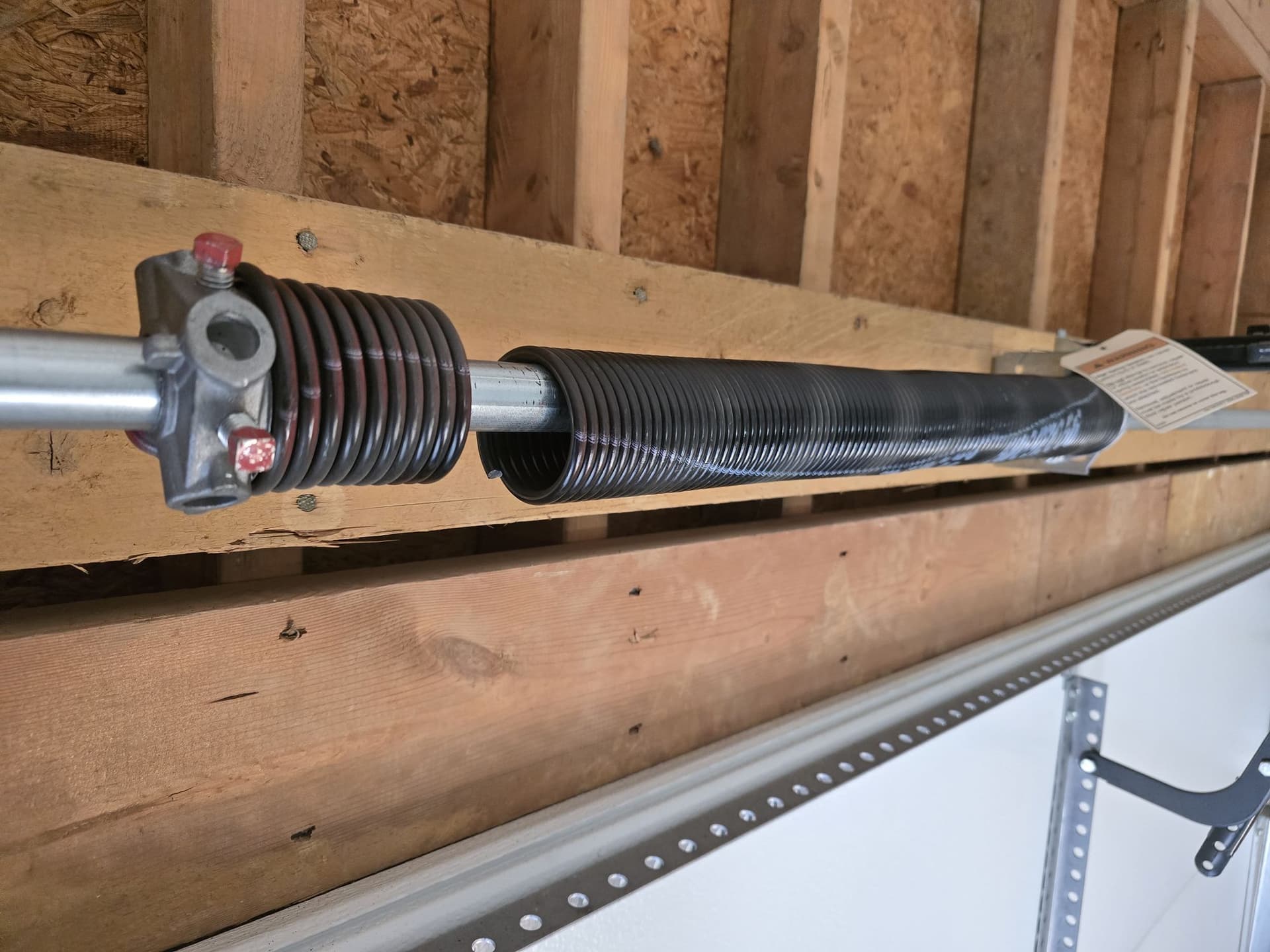
- A gap in the coil, even a small one. A torsion spring that has separated anywhere is done.
- Visible rust, flaking, or pitting along the coil.
- The door jerks on the way up, or stops partway and sags.
- The door won't stay put when you lift it halfway by hand. It slams down or shoots up.
- The opener strains and the door sounds heavier than it used to.
- Stretched-out gaps between the coils, so one spring looks longer and looser than its partner.
If your door has started making a noise it didn't make last year, that's worth acting on. The sounds a garage door makes each point at something specific, and a straining opener on an aging spring is one of the clearer ones.
Are high-cycle springs worth the money?
For some doors, yes. Whether it makes sense for yours comes down to how often the door runs, and you can work that out at your own kitchen table.
A high-cycle spring costs more up front, usually in the range of $75 to $200 over a standard spring, and full spring replacement across the DMV generally lands between $200 and $800 all-in, with custom and oversized doors running above that. What you buy is roughly double the life.
If your door runs twice a day, a standard spring already outlasts most people's time in the house and the upgrade is money you don't need to spend. If your door runs six or eight times a day, you're looking at a replacement every four years or so on standard springs, and the high-cycle version pays for itself the first time you don't have to make that call. Heavy insulated doors and wide double doors are the other good case, because there's more weight on the spring every cycle regardless of how often it runs.
Either way, you get a flat price for the whole job before any work starts, so you can compare the two options against each other with real numbers instead of a guess.
A real one from Bethesda
A Bethesda homeowner called us about a broken spring on an older, heavier door, the kind you find all over the established streets there where mid-century houses got hung with substantial doors and then kept them for decades. He'd already talked to two other companies before we showed up.
The springs that door needed weren't the ones sitting on a van shelf. Getting a full 10,000-cycle life out of it meant sourcing the correct springs for that door's actual weight, which took extra time, and I told him that instead of putting on what I had and calling it done. His review afterward said he found us more transparent than the two other companies he'd interviewed. Sizing the spring correctly takes longer than installing it, and it's also why two doors that look identical on the same street can get very different lifespans out of what the invoice calls the same spring.
What you can do to get the full life out of them
You can't service a spring while it's under tension, and you shouldn't try. Most of what extends spring life happens elsewhere on the door.
- Once or twice a year, spray a light garage door lubricant on the springs, rollers, hinges, and bearings. Not WD-40, which cleans rather than lubricates. Use a proper silicone or lithium garage door spray.
- Run the balance test every few months: pull the release cord with the door closed, lift the door halfway by hand, let go. A balanced door holds roughly still. One that drops or rises needs adjustment.
- Keep the tracks clear and the rollers turning. A dragging door pulls on its springs harder than it should.
- Don't ignore a new noise. A dry roller costs very little to sort out and a good deal more once it has chewed up a track.
- Get the whole system looked at once a year, which catches the balance and hardware problems that quietly shorten spring life.
An annual tune-up is where most of that gets handled. And when a spring does go, leave the door alone until a tech gets there. Here's what to do in the first five minutes after a spring snaps. We run same-day spring service across Montgomery County, DC, and Northern Virginia.